
Taj Mahal Quartzite: A Study in Quiet Strength
Introduction · What Draws Designers In
Material decisions in serious projects rarely begin with spectacle. They begin with questions of balance—how a surface will carry light, how it will read at scale, how it will age alongside architecture rather than compete with it. Taj Mahal Quartzite often enters these conversations not because it demands attention, but because it holds it.
Sourced primarily from Brazil, this quartzite has become a reference point for designers and architects seeking restraint without austerity. Its appeal lies in clarity: a legible palette, a composed surface, and performance characteristics that align with long-term use. What follows is a closer look at how the stone is understood by professionals—visually, materially, and architecturally—and why it continues to earn consideration in high-quality interiors.
Visual Character & Natural Variation
Taj Mahal Quartzite is defined by a warm, understated spectrum. Its base tones typically range from soft ivory to pale greige, with subtle inflections of honey, sand, and occasional silvery movement. Veining is present but measured—fine, linear passages that drift across the surface rather than cut through it. The effect is neither static nor dramatic; it is quietly active, offering depth without visual noise.
Natural variation is an essential part of how the stone is read. No two slabs are identical, and experienced specifiers understand that the nuance from block to block is what gives the material credibility. When viewed across a large plane, these variations register as softness and continuity rather than inconsistency.
Designers often note several visual characteristics during selection:
A translucency that allows light to sit within the stone rather than on top of it
Veining that feels atmospheric, more like weathering than pattern
A surface calm enough to support both contemporary and traditional detailing
Finish plays a significant role in how these qualities are perceived. Polished surfaces emphasize clarity and reflectivity, while honed finishes soften contrast and heighten the stone’s tactile presence. In either case, the material retains its composure.
Material Performance & Behavior
As a true quartzite, Taj Mahal is formed through metamorphic processes that result in a dense, interlocking crystalline structure. This composition gives the stone a level of durability that is well understood among professionals specifying for kitchens, baths, and other high-use environments.
Its behavior is generally predictable, which is part of its appeal. The stone resists etching more effectively than many marbles and maintains surface integrity under daily use when properly finished and maintained. Like all natural stone, it benefits from sealing, but this is viewed as a standard aspect of stewardship rather than a special accommodation.
From a performance standpoint, several attributes are commonly recognized:
High density that contributes to strength and longevity
Surface resilience suited to functional architectural applications
Consistent behavior across slabs when sourced and fabricated with care
These qualities allow the material to move confidently between aesthetic and functional roles, supporting both without compromise.
Architectural & Interior Application
Taj Mahal Quartzite performs best when allowed to do less. In interiors where proportion, light, and material hierarchy are carefully considered, the stone acts as a stabilizing element. Its coloration responds gently to natural light, warming morning spaces and maintaining neutrality under evening conditions.
At scale, the stone excels in creating continuity. Large-format applications—extended countertops, full-height wall planes, integrated backsplashes—benefit from its even movement and tonal consistency. Rather than fragmenting a space, it reinforces cohesion, allowing cabinetry, metalwork, and wood elements to assert their own character.
Architects often appreciate how the stone mediates between styles. It can support minimal detailing without feeling cold, and it can sit comfortably alongside more traditional profiles without appearing nostalgic. This flexibility is not about adaptability in a trend-driven sense, but about material intelligence—how a surface understands its role within a larger composition.
Selection, Judgment, and Expertise
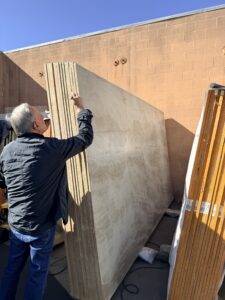
While digital imagery has expanded access to materials, it has not replaced the value of in-person evaluation. Taj Mahal Quartzite, in particular, reveals its subtleties through proximity. The way light moves across a slab, the softness of its transitions, and the scale of its veining are qualities best understood firsthand.
Seasoned professionals approach selection as an act of judgment rather than preference. They look for balance across multiple slabs, consider how seams will read, and evaluate how the stone’s natural variation will resolve once installed. This process is less about finding perfection than about recognizing coherence.
Within this ecosystem, long-standing suppliers such as GEM International play a quiet but important role—facilitating access, providing continuity of material knowledge, and supporting informed decision-making without directing it. The outcome rests on collaboration and experience, not assertion.
In the Long View
Taj Mahal Quartzite endures because it resists easy categorization. It is neither overtly expressive nor purely neutral. Instead, it offers a measured presence that rewards attention over time. In projects where longevity matters—where materials are expected to settle into daily life rather than announce themselves—the stone proves its worth through consistency and calm.
Its continued relevance is less about fashion and more about fit. When chosen with care and understood on its own terms, Taj Mahal Quartzite becomes part of the architecture itself, supporting spaces that feel resolved rather than composed for effect.
For those interested in engaging the material more closely, experiencing slabs in person and discussing their nuances with stone specialists can offer clarity beyond images. Visits to established showrooms, including those of GEM International, often become part of this broader, unhurried process—one that values understanding as much as outcome.