
Marble vs. Quartzite: Understanding the Right Natural Stone for a Luxury Home
Understanding the Material
Choosing between marble and quartzite is rarely a purely aesthetic decision. In refined residential work, material selection sits at the intersection of appearance, performance, scale, and the way a surface will be lived with over time. Two stones may appear similar in a photograph, yet behave very differently once installed across a kitchen island, bathroom wall, fireplace surround, or large-format architectural surface.
Marble and quartzite often enter the same conversation because both offer natural movement, depth, and individuality. Each slab carries geological character that cannot be replicated in a manufactured surface. Still, their differences matter. Marble is typically selected for its softness of movement, classical associations, and ability to bring a room a sense of calm or drama depending on the variety. Quartzite is often considered when a project calls for natural stone with greater density, crystalline depth, and stronger everyday resilience.
For homeowners, designers, architects, and builders, the decision is less about declaring one stone superior and more about understanding what each material naturally offers. The right choice depends on where the stone will be used, how the space functions, and what kind of visual language the project requires.
Visual Character & Natural Variation
Marble is known for its expressive range. Some marbles are quiet and atmospheric, with soft grey movement across a pale ground. Others are highly graphic, with bold veining, brecciation, or dramatic contrast. Its beauty often comes from the way the veining appears suspended within the surface, creating a sense of depth even in a polished finish.
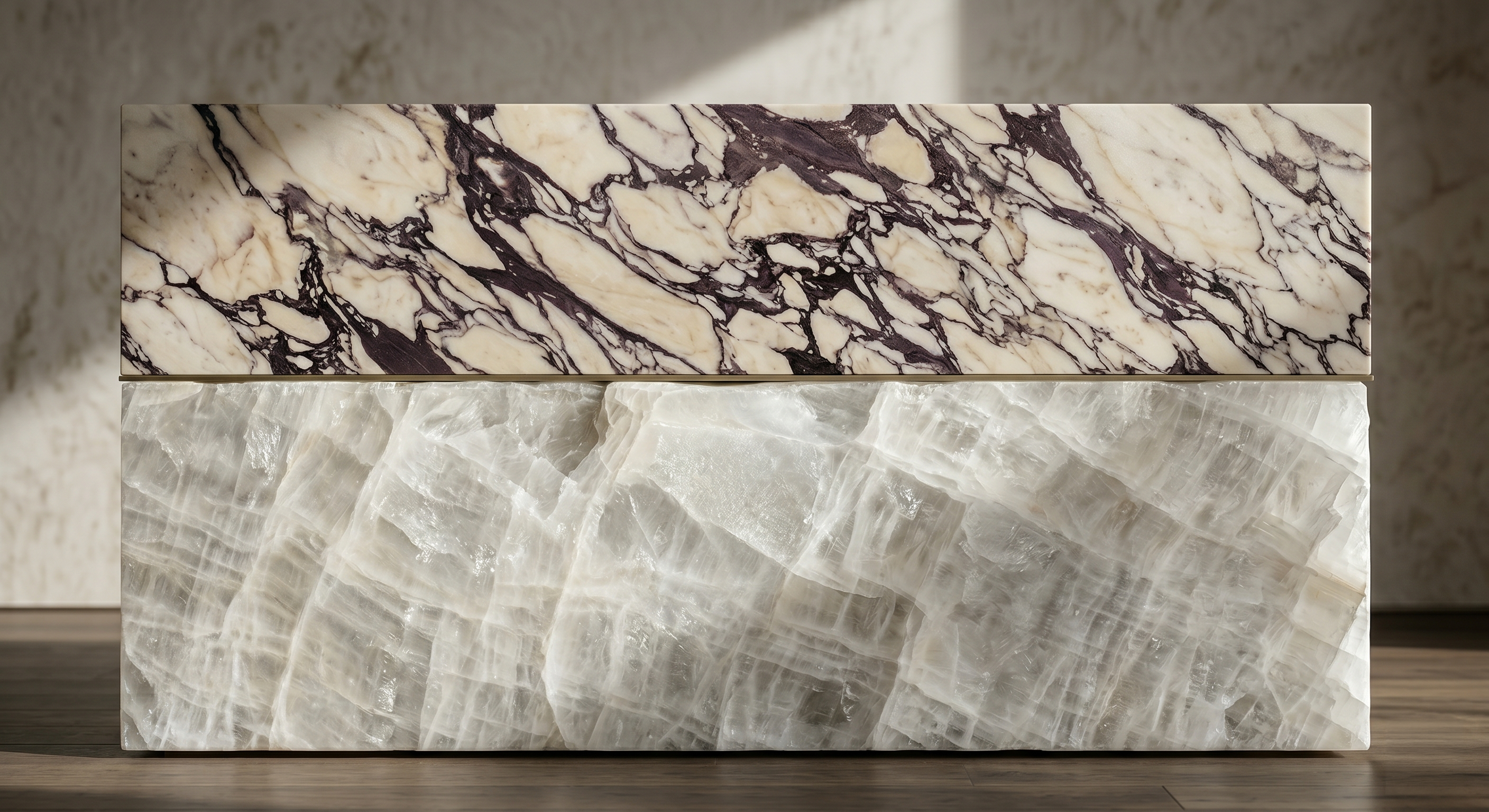
Quartzite tends to carry a different kind of visual energy. Many quartzites have a crystalline structure that gives the surface a layered, luminous quality. The movement can be linear, clouded, sweeping, or heavily veined, depending on the quarry and block. Some varieties resemble marble visually, while others read closer to landscape, mineral, or abstract painting.
Natural variation is central to both materials. It is not an inconsistency; it is the defining quality of the stone. A slab may shift in tone from one end to another. Veining may gather, open, fracture, or dissolve. These variations are what allow a surface to feel specific to a project rather than interchangeable.
Several visual distinctions often become clear during selection:
- Marble often reads softer and more atmospheric, especially in honed or lightly polished finishes.
- Quartzite often carries more crystalline depth, with light interacting through the surface in a more mineral way.
- Marble veining can feel painterly, architectural, or classical, depending on the slab.
- Quartzite movement can feel layered, directional, or landscape-like, especially across larger surfaces.
- Both materials change significantly in person, where scale, finish, and lighting reveal qualities that photography cannot fully capture.
Material Performance & Behavior
The primary difference between marble and quartzite lies in composition and behavior. Marble is a metamorphic stone formed primarily from calcite or dolomite. Because of this mineral makeup, it is more reactive to acids and more susceptible to etching. Etching is not the same as staining; it is a surface reaction that can appear as a dull mark, especially on polished marble.
Quartzite begins as sandstone and is transformed through heat and pressure into a dense, quartz-rich stone. True quartzite is generally harder and more resistant to scratching and acid exposure than marble. That said, natural stone categories can be misunderstood in the market. Some materials sold under quartzite-adjacent names may behave differently, which is why careful sourcing and material knowledge matter.
Both marble and quartzite benefit from proper sealing, thoughtful fabrication, and realistic expectations about use. Stone is not inert decoration. It is a natural surface that develops a relationship with the home. In some interiors, a marble kitchen island that slowly gains a softer patina is entirely appropriate. In others, especially where heavier cooking, entertaining, or daily use is expected, quartzite may align more closely with the performance needs of the space.
“Material selection becomes clearer when stone is evaluated at full scale, where movement, light, finish, and proportion can be understood together.”
The most important considerations are usually straightforward:
- Marble is more sensitive to acids, including citrus, wine, and certain cleaners.
- Quartzite is generally denser and harder, though performance still varies by specific stone.
- Both materials may require sealing, depending on porosity, finish, and application.
- Finish affects behavior, with honed surfaces often concealing wear differently than polished surfaces.
- Fabrication quality is essential, particularly for veining alignment, edge details, and large-format installations.
Architectural & Interior Application
In architecture and interiors, marble and quartzite each bring a distinct presence. Marble has a long association with permanence, refinement, and craft. It can make a bathroom feel composed and enveloping, a fireplace feel architectural, or a kitchen feel anchored by material history. Its strength is not only visual drama, but also the softness it can bring to a room.
Quartzite often performs beautifully where scale and continuity matter. Large kitchen islands, full-height backsplashes, integrated vanities, bar surfaces, and feature walls can benefit from quartzite’s density and depth. The material often holds its presence across wide planes without feeling flat. In many projects, quartzite gives designers the ability to introduce movement while maintaining a sense of restraint.
Light plays a major role in both stones. A heavily veined marble may become more dramatic under direct light, while a crystalline quartzite may reveal translucency, shimmer, or mineral layering as the day changes. The same slab can feel different in morning light, under recessed lighting, or beside warm wood cabinetry.
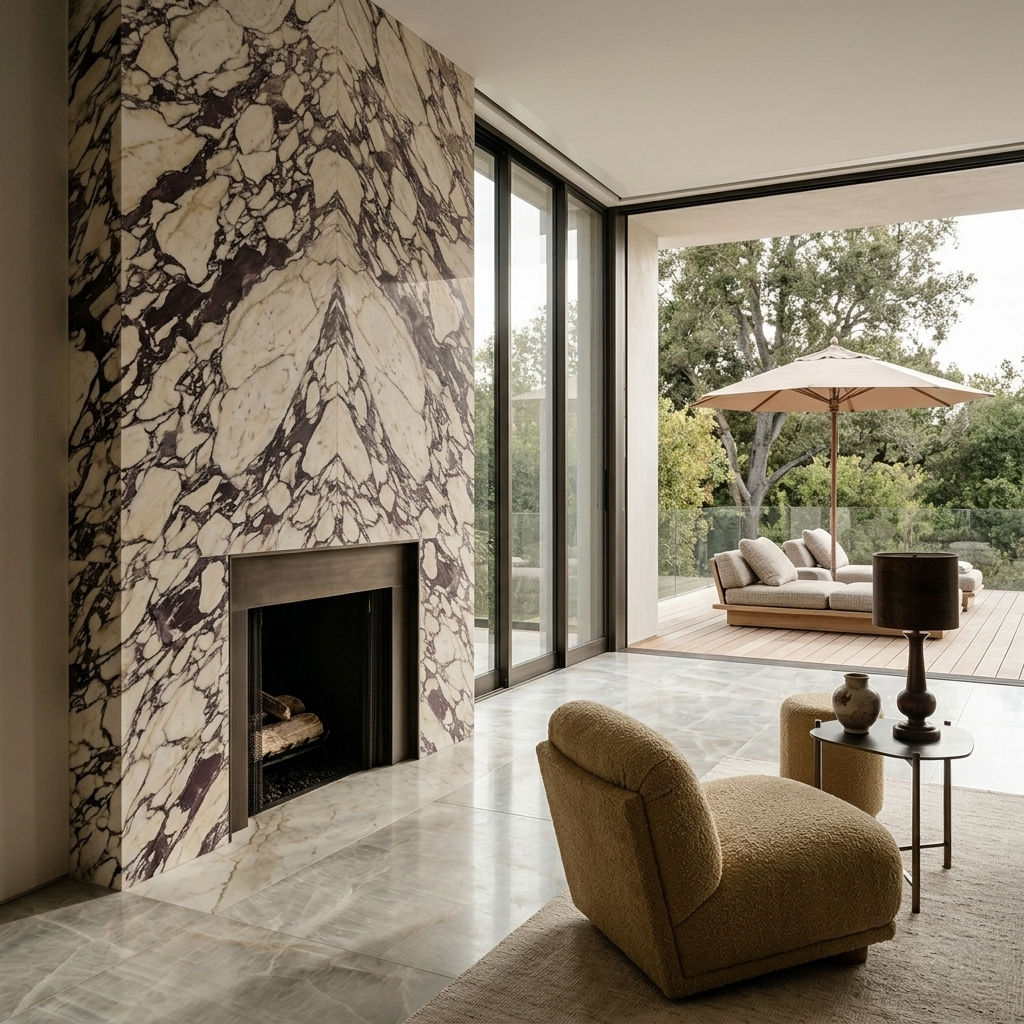
Scale is equally important. A small sample can communicate color, but it cannot communicate movement. A full slab reveals rhythm, proportion, and the relationship between veining and usable surface area. This is especially relevant when the design calls for bookmatching, waterfall edges, full-height cladding, or a stone surface intended to become the visual center of the room.
Selection, Judgment, and Expertise
Digital viewing has made early material research easier, but it has also created a false sense of certainty. Stone does not fully reveal itself on a screen. Color temperature shifts. Veining scale compresses. Surface depth disappears. A slab that appears quiet in a photograph may feel powerful in person; another that looks dramatic online may not carry the same refinement at full scale.
Experienced designers and fabricators often evaluate stone through a different lens. They look at movement, usable area, vein direction, fissures, finish, thickness, and how the slab will behave once cut. They also consider the surrounding architecture: cabinetry tone, lighting, metal finishes, flooring, sightlines, and the way the stone will be encountered in daily life.
This is where the showroom experience remains important. At GEM International in Los Angeles, material selection is part of a broader professional conversation around stone, scale, and application. The value is not in overwhelming the eye with options, but in understanding how a specific slab may behave within a specific project.
A thoughtful selection process also avoids reducing marble and quartzite to simple categories. Not every marble is delicate in the same way. Not every quartzite performs identically. Each stone deserves to be evaluated individually, with its own mineral composition, finish, and intended use taken into account.
In the Long View
Marble and quartzite both have a place in luxury residential design because they offer something beyond surface coverage. They bring natural variation, geological depth, and a level of individuality that gives a project its own material identity.
Marble is often chosen when softness, history, and expressive veining are central to the design. Quartzite is often chosen when natural movement is desired alongside greater density and everyday resilience. The distinction is practical, but also atmospheric. One may bring quiet elegance. The other may bring layered strength. Both can feel refined when selected with care.
The strongest material decisions are rarely rushed. They come from looking closely, understanding performance, and allowing the architecture to guide the choice. In that sense, the question is not simply whether marble or quartzite is right. The better question is which specific stone belongs in the room, at that scale, under that light, for the way the space will actually be used.
For those considering marble or quartzite for a current project, experiencing the slabs in person remains the clearest way to understand their presence. GEM International’s Los Angeles showroom offers the opportunity to view natural stone at full scale and continue the conversation with specialists who work closely with designers, architects, builders, and homeowners.