
The Art of Bookmatching: How Natural Stone Becomes a Statement Piece
Understanding the Gesture
In natural stone, some design decisions are quiet by nature. A honed limestone floor, a restrained travertine wall, or a softly veined marble vanity may support a room without asking to dominate it. Bookmatching belongs to a different category. It is still grounded in material intelligence, but its effect is more architectural, more deliberate, and more visibly composed.
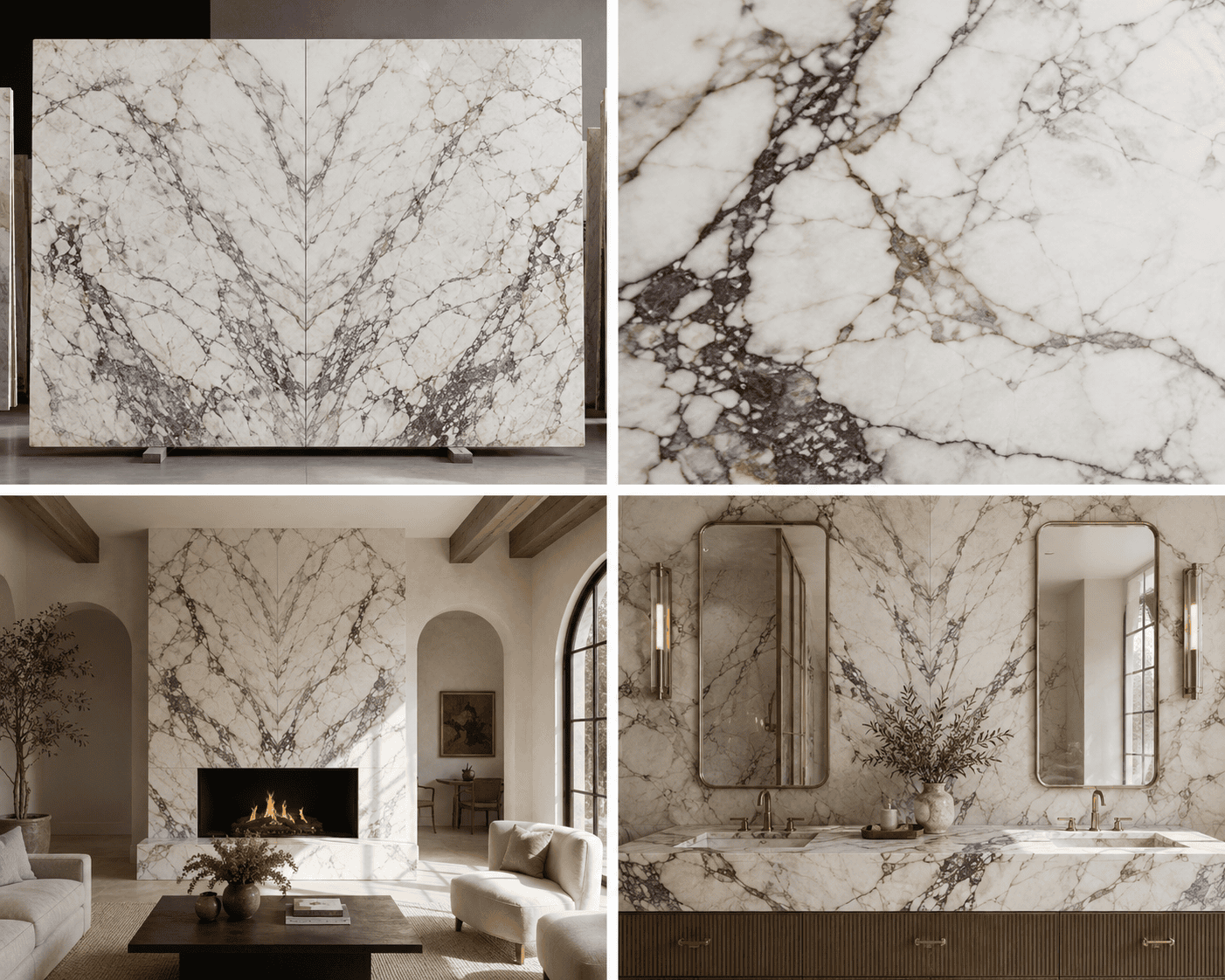
Bookmatching refers to the practice of placing two consecutive slabs beside one another so their veining mirrors across a central seam. The effect is often compared to opening the pages of a book, with one slab becoming the reflection of the other. In the right setting, this creates a broad, continuous field of movement: veins appear to meet, expand, branch, or unfold across the surface.
The result can be dramatic, but the purpose is not spectacle alone. Designers use bookmatching because it gives natural stone a sense of order without removing its irregularity. It allows a wall, fireplace, island, shower, or vanity backdrop to feel intentional while still preserving the geological character that makes the material compelling in the first place.
Visual Character & Natural Variation
A successful bookmatch begins with the stone itself. The strongest candidates usually have clear directional movement, pronounced veining, or color shifts that can carry across more than one slab. Marble, quartzite, onyx, and some granites often lend themselves to this approach because their patterns may contain enough visual structure to create a mirrored composition.
The visual language can vary widely. A white marble with soft grey veining may produce a quiet, almost atmospheric symmetry. A richly colored quartzite may create something more painterly, with sweeping bands of mineral movement meeting across the center. Onyx, especially when backlit, can transform bookmatching into an architectural light feature, where translucency and pattern become part of the room’s mood.
Natural variation remains central to the result. Bookmatching does not erase the unpredictable qualities of stone. It organizes them. Slight differences in tone, mineral concentration, veining intensity, or slab thickness may remain visible, and these distinctions are part of the material’s authenticity.
Designers often evaluate several visual qualities before deciding whether a slab sequence is suitable for bookmatching:
The strength and direction of the veining across the slab face
The balance between background color and mineral movement
The way the mirrored pattern meets at the center seam
The scale of the pattern relative to the wall, island, fireplace, or shower surface
The relationship between the stone’s movement and the surrounding architecture
Material Performance & Behavior
Bookmatching changes the visual reading of stone, but it does not change the stone’s inherent performance. The material still behaves according to its type, density, finish, porosity, and installation environment. This distinction matters because the beauty of a bookmatched surface should be considered alongside how the stone will live in the space.
Marble, for example, brings depth, softness, and a long architectural history, but it carries the characteristics of a calcite-based material. Quartzite often offers greater density and a crystalline structure that can suit demanding interior applications. Granite is known for its structural resilience and granular composition. Onyx is valued for translucency and visual drama, while limestone and travertine tend to create calmer, more textural surfaces.
In professional selection, maintenance is not treated as an afterthought or a warning. It is part of understanding the material honestly. Sealing, finish choice, fabrication quality, and daily use all influence how a surface develops over time. A polished bookmatched wall in a powder room will age differently from a kitchen island, just as a shower wall introduces different conditions than a fireplace surround.
For this reason, the conversation around bookmatching is rarely only about pattern. It is also about placement, proportion, finish, lighting, and the expectations of the room.
Architectural & Interior Application
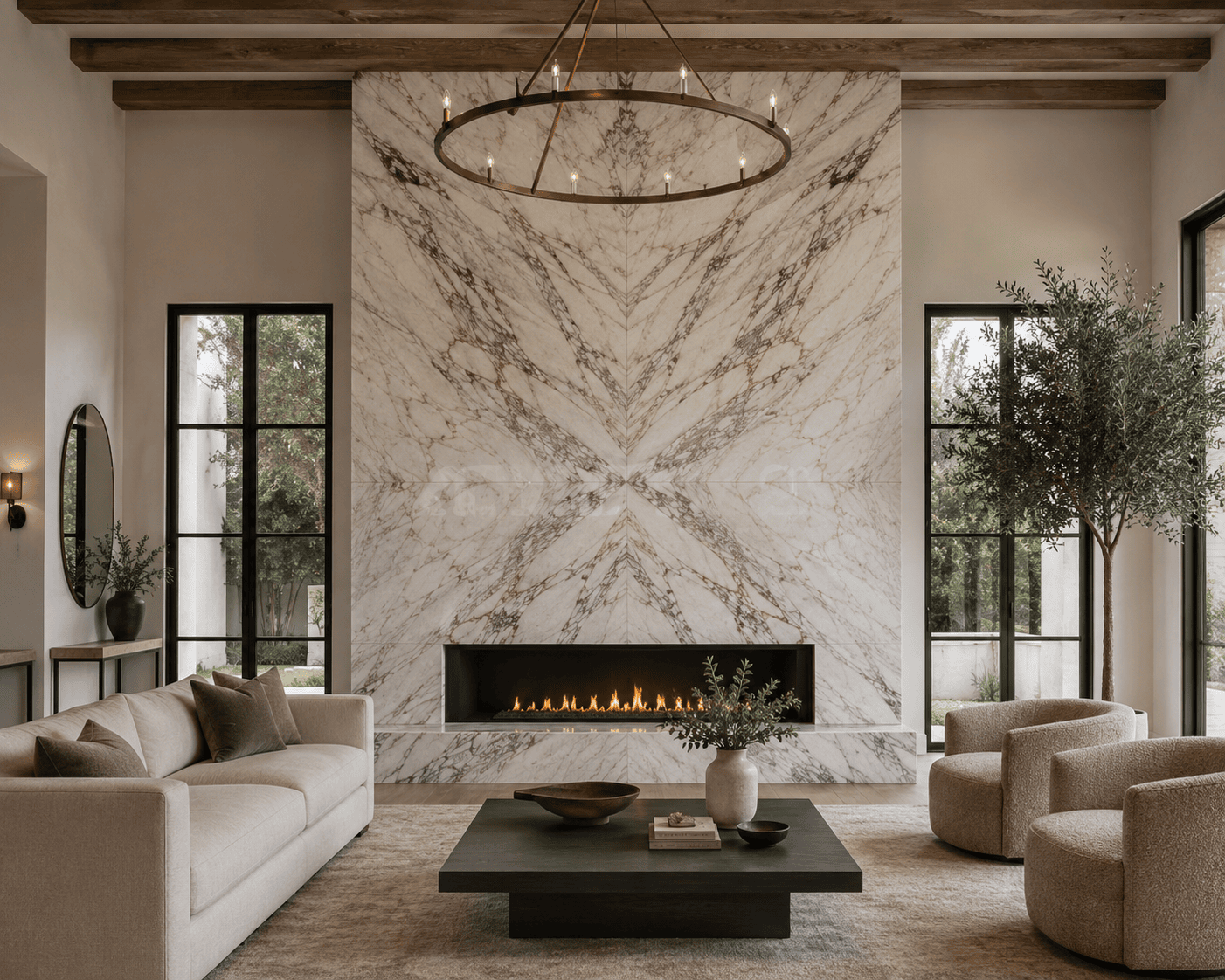
Bookmatching works best when the architecture gives it enough space to be read clearly. A narrow surface may not allow the mirrored movement to fully unfold. A larger vertical plane, by contrast, can give the stone room to act almost like a mural, while still remaining materially grounded.
“Bookmatching is powerful because it brings order to natural variation, allowing stone to feel both composed and unmistakably alive.”
Fireplaces are one of the clearest examples. A bookmatched stone fireplace can anchor a living room without requiring additional ornament. The central seam gives the composition symmetry, while the veining introduces movement and depth. In more restrained interiors, this contrast between order and natural irregularity can be especially effective.
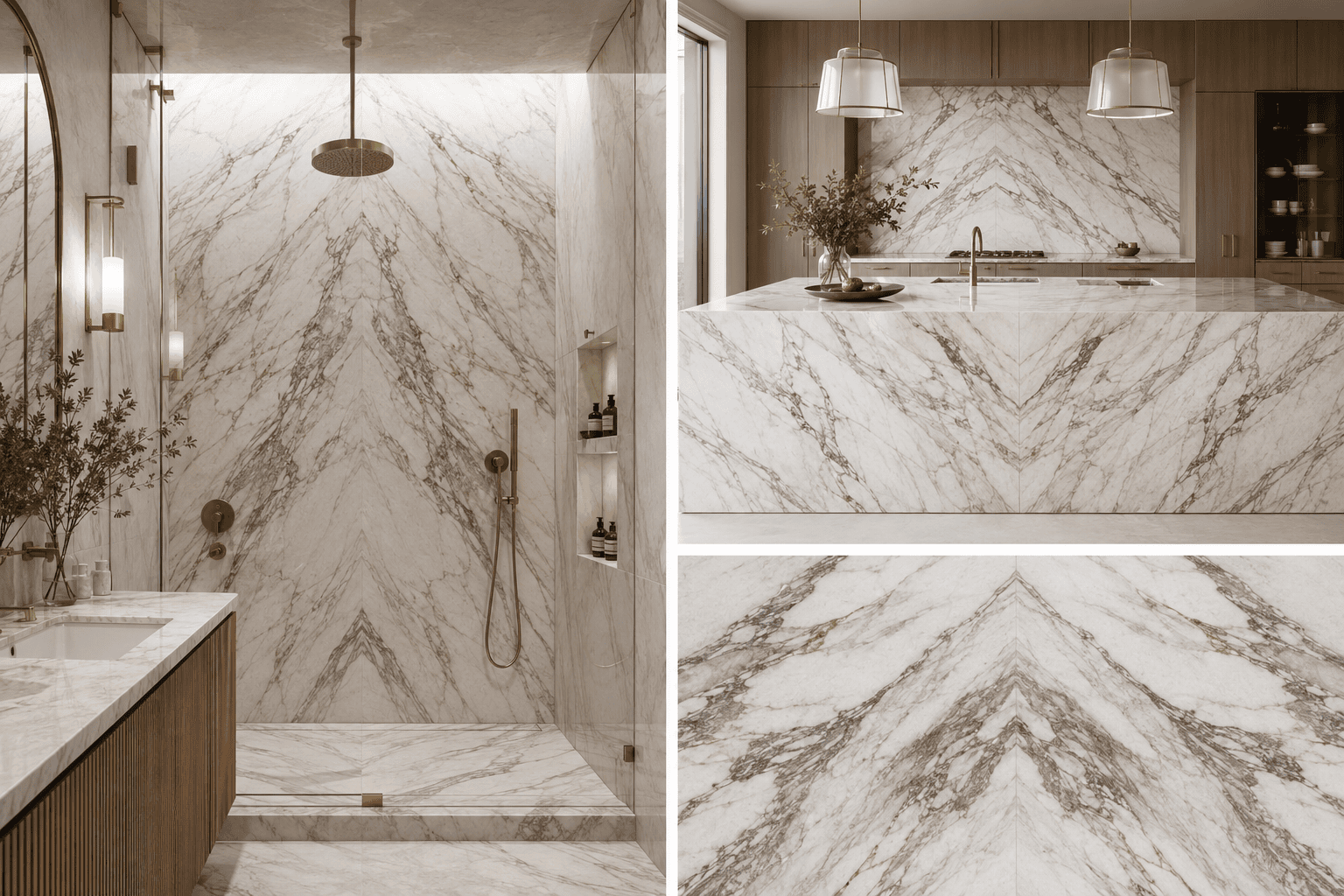
Shower walls and hotel-style bathrooms also benefit from bookmatching because these spaces often rely on fewer materials and cleaner planes. When the stone is carried across a wall behind a vanity, through a shower enclosure, or across a tub surround, the room gains a sense of continuity. The effect is less about decoration and more about atmosphere.
Kitchen islands use bookmatching differently. The horizontal plane changes the way the pattern is experienced. Instead of reading as a frontal composition, the stone becomes a surface encountered from multiple angles. Strongly veined slabs can turn an island into the central visual weight of the room, particularly when cabinetry, lighting, and surrounding finishes remain quiet.
Feature walls, reception areas, bars, and powder rooms allow for a more expressive use of the technique. In these settings, bookmatching can create a focal point that feels permanent rather than applied. The stone is not added as an accessory. It becomes part of the architecture.
Selection, Judgment, and Expertise
Digital images can introduce a stone, but they rarely tell the full story of a bookmatch. Scale is difficult to judge on screen. Color may shift under different lighting. A vein that looks subtle in a photograph may feel powerful in person, while a dramatic slab may require more space than expected to avoid feeling compressed.
In-person selection reveals the details that matter: the rhythm of the veining, the balance between the two slabs, the way the seam reads from a normal viewing distance, and the relationship between surface finish and light. Even small decisions can affect the final composition. Where the slabs are cut, how they are aligned, and how the stone is framed by adjacent materials all influence whether the result feels refined or forced.
This is where professional judgment becomes valuable. Designers, fabricators, builders, and stone suppliers all contribute to the success of a bookmatched installation. GEM International’s role in this broader process is best understood within that professional ecosystem: helping connect material selection with the realities of slab character, project scale, and design intent.
A strong bookmatch does not need to be the loudest element in a room. It needs to feel resolved. The most successful examples are those where the stone’s movement has been given enough presence, but not so much visual competition that the material loses clarity.
In the Long View
Bookmatching endures because it expresses something specific about natural stone: no two slabs are identical, yet two related slabs can create a moment of remarkable alignment. The technique respects both the irregularity of geology and the discipline of design.
Its appeal is not limited to dramatic interiors. A quiet marble, a richly veined quartzite, a translucent onyx, or a deeply patterned granite can each become compelling when handled with restraint. The difference lies in judgment: knowing when the material has enough movement to carry the gesture, when the architecture can support it, and when the surrounding elements should step back.
For designers, architects, builders, and homeowners considering bookmatched stone, the most useful decisions usually happen slowly and in person. Seeing the slabs at full scale, studying the movement, and discussing the possibilities with experienced stone specialists can clarify what photographs alone cannot. For those continuing that conversation, the GEM International showroom offers a setting to experience the material directly and consider how a bookmatched surface might belong within a larger architectural vision.