
A Deeper Reading of Green Stone
Green stone has a particular way of changing the atmosphere of a room. It does not rely on brightness alone, nor does it behave as a neutral in the conventional sense. Its presence is quieter than many highly figured marbles, but often more complex than a surface chosen simply to recede. In refined interiors, green marble, green quartzite, and other natural green stones are increasingly considered for the depth they bring to a palette, the way they interact with light, and the sense of permanence they can introduce into contemporary spaces.
Part of the appeal lies in restraint. Green stone can feel historic without being nostalgic, expressive without feeling decorative, and grounded without becoming heavy. Stones such as Moulin Vert and Verde Aver show why this material family continues to interest designers, architects, and homeowners who are looking for surfaces with character, but not spectacle. Their color is important, but it is only one part of the larger material conversation.
A successful stone selection is rarely about choosing a color in isolation. It involves looking at movement, scale, finish, density, edge detail, surrounding materials, and the way the slab behaves under actual light. Green stone rewards that slower evaluation. It asks to be read as a natural material rather than a flat surface category.
Visual Character and Natural Variation
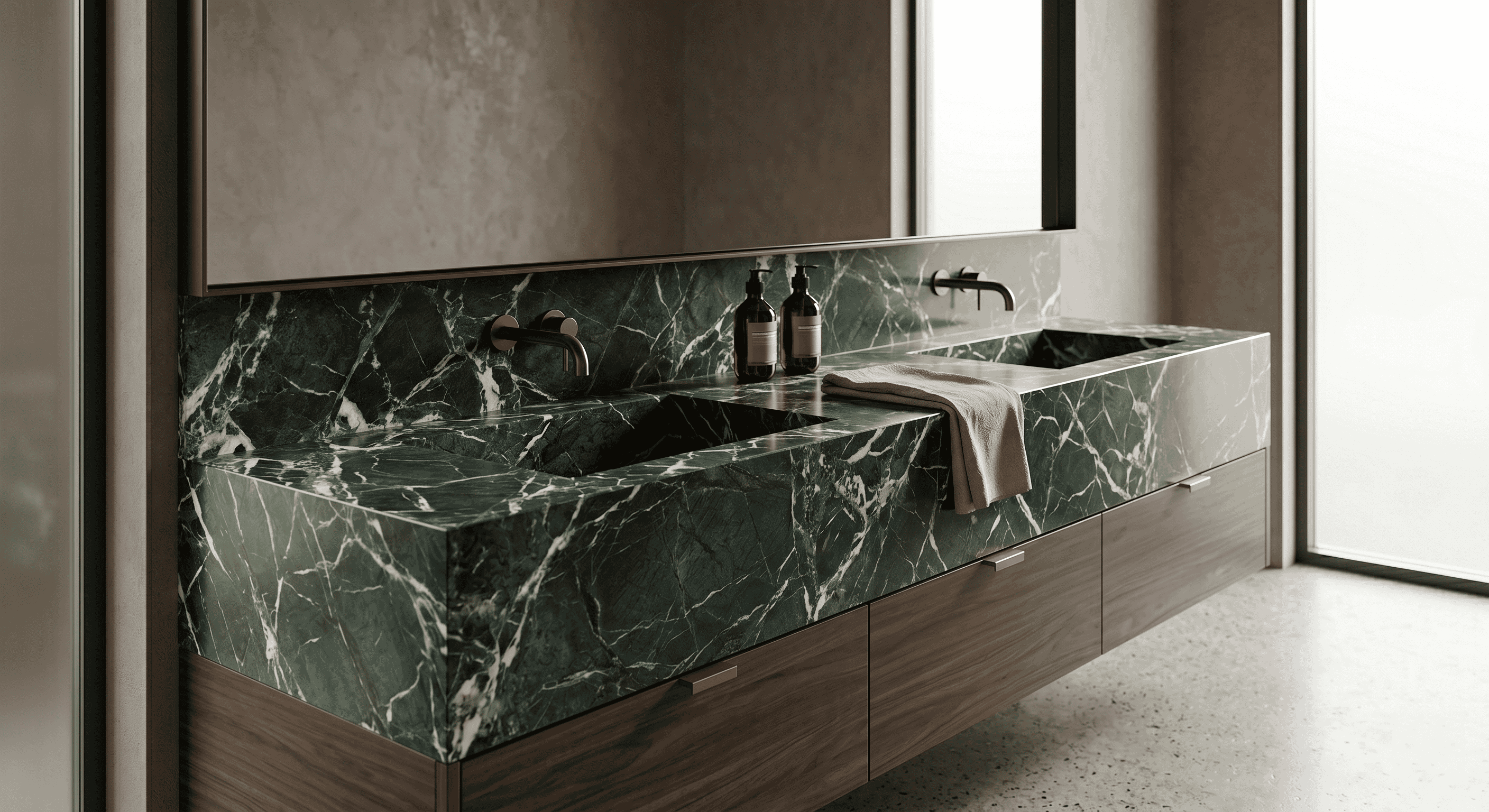
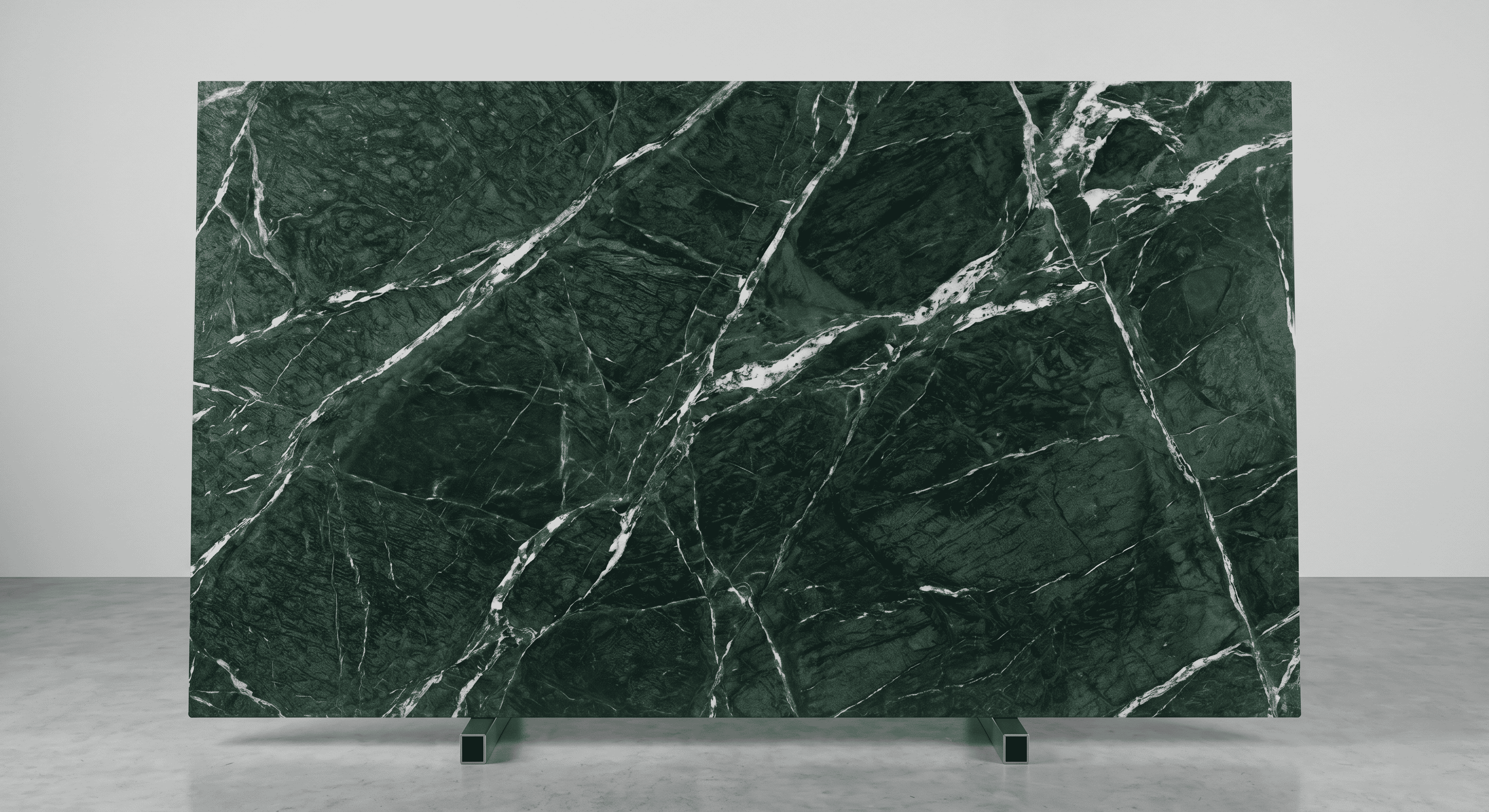
Green stone carries an unusually broad visual range. Some slabs lean toward deep forest tones, with dense mineral movement and a sense of shadow. Others appear softer and more atmospheric, with olive, moss, sage, jade, or gray-green undertones that shift depending on the light. In certain marbles, the veining may appear white, charcoal, gold, cream, or burgundy. In some quartzites, the movement can feel more crystalline, layered, or directional, with a different kind of depth across the surface.
This variation is part of what makes green stone so compelling in interiors. Unlike a painted wall or manufactured surface, the color is not fixed in a single register. It changes through mineral composition, finish, lighting, and proximity to other materials. A polished finish may bring out depth, contrast, and reflection. A honed finish may soften the reading of the stone and allow the green to feel more architectural, especially in rooms where the goal is calm rather than drama.
Several qualities tend to stand out during selection:
Depth of tone, especially where green moves between shadowed and illuminated areas rather than appearing flat.
Mineral movement that gives the slab rhythm, direction, or visual weight.
Undertones that influence how the stone relates to wood, metal, plaster, tile, and surrounding textiles.
Scale of veining, which determines whether the material reads as quiet background, focal surface, or architectural gesture.
Finish, which can shift the stone from reflective and formal to softer and more tactile.
Natural variation should not be understood as inconsistency. It is the language of the material. The most successful uses of green stone often come from recognizing that no two slabs carry color and movement in exactly the same way. That individuality is not incidental to the design. It is often the reason the material is chosen.
Material Performance and Behavior
Green stone can refer to several material types, and each behaves differently. Green marble, green quartzite, green granite, and other natural stones may share a color family, but they do not share identical properties. This distinction matters because professional selection considers both appearance and behavior. A stone’s density, porosity, hardness, finish, and intended application all shape how it performs over time.
Marble is valued for its depth, movement, and softness of visual character. It develops a surface life that many designers appreciate, especially in interiors where natural materials are allowed to age with grace. Quartzite tends to be denser and more resistant in many applications, while still offering natural variation and layered visual interest. Granite can provide strong performance and a more granular mineral structure. The name of the stone matters, but the specific slab, finish, and fabrication details matter just as much.
Maintenance is best understood as part of ownership rather than as a complication. Natural stone benefits from appropriate sealing, careful fabrication, and informed use. In kitchens, baths, fireplaces, bars, and architectural surfaces, the long-term result depends on matching the stone to the setting and expectations. Designers and fabricators typically consider how the surface will be used, how frequently it will be touched, how much exposure it will have to moisture or acidity, and whether the chosen finish supports the atmosphere of the room.
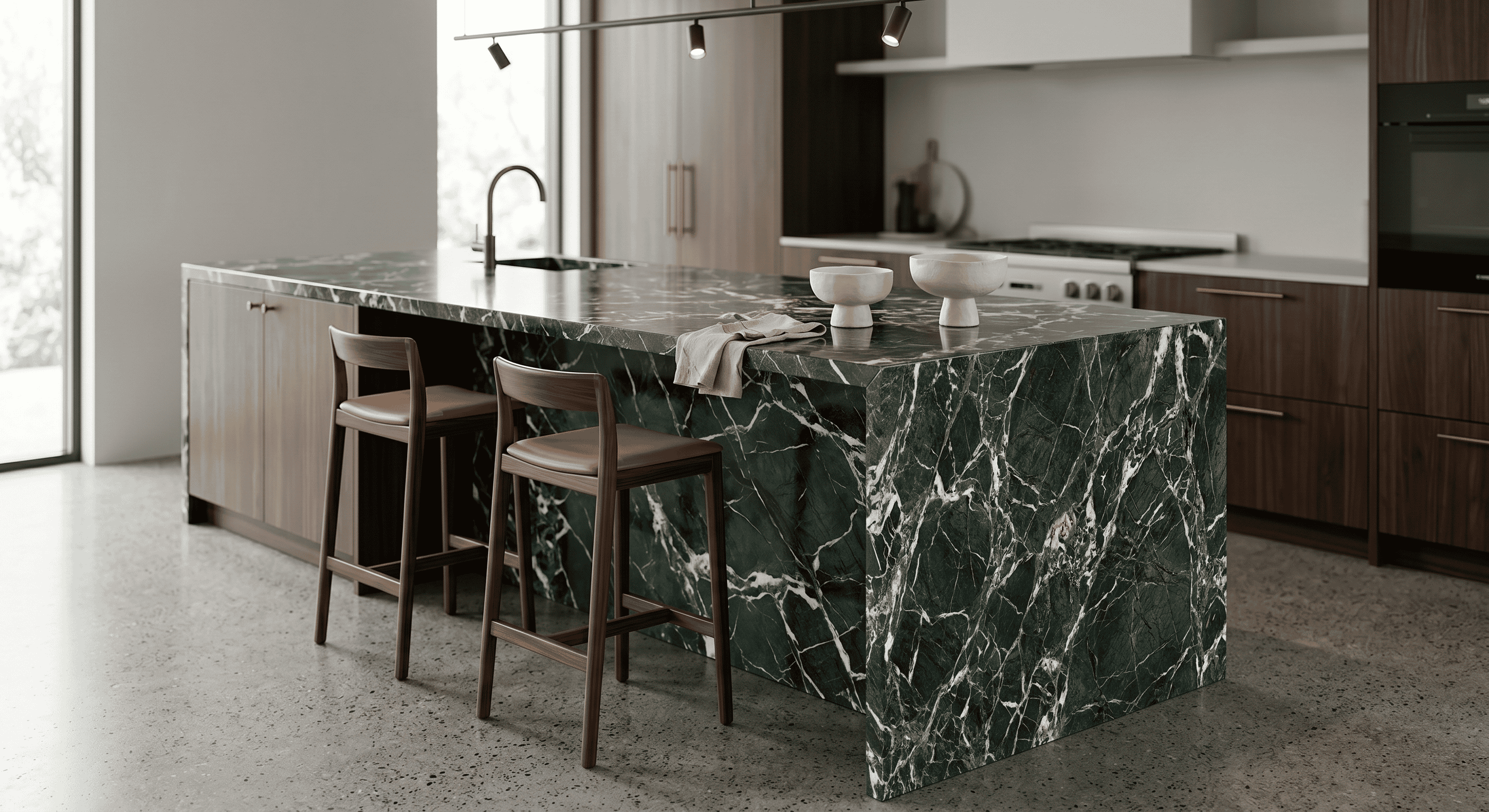
This is where green stone becomes especially interesting. Its darker and more variegated surfaces can often hold visual depth beautifully, while also requiring thoughtful attention to finish and detailing. A honed green marble may read as quiet and velvety. A polished green quartzite may carry more light and structure. A bookmatched installation may emphasize symmetry and drama, while a more restrained slab placement may allow the material to settle naturally into the architecture.
Green stone is rarely selected for color alone. Its strength lies in the way tone, movement, density, and light work together over time.
Architectural and Interior Application
In interiors, green stone works best when it is given enough room to participate in the architecture. It can be used as a countertop, vanity, fireplace surround, shower wall, bar surface, flooring, or feature wall, but its success depends less on the category of application and more on proportion. A small surface can become a jewel-like moment. A larger surface can define the mood of an entire room. The same slab may feel intimate in a powder room and monumental across a kitchen island.
Green also has a rare ability to sit between natural and formal palettes. It pairs easily with walnut, oak, bronze, unlacquered brass, plaster, cream, charcoal, and soft whites. In more contemporary interiors, it can introduce depth without relying on high contrast. In traditional or transitional settings, it can connect to older ideas of permanence, craft, and material richness without feeling overly ornate.
Light is one of the central considerations. In a bright room, green stone may reveal more tonal variation and mineral complexity. In a darker room, it may become moodier and more enveloping. Artificial lighting can either flatten the surface or bring forward the veining, depending on temperature and placement. Designers often evaluate green stone not only under showroom lighting, but also in relation to the actual conditions of the project.
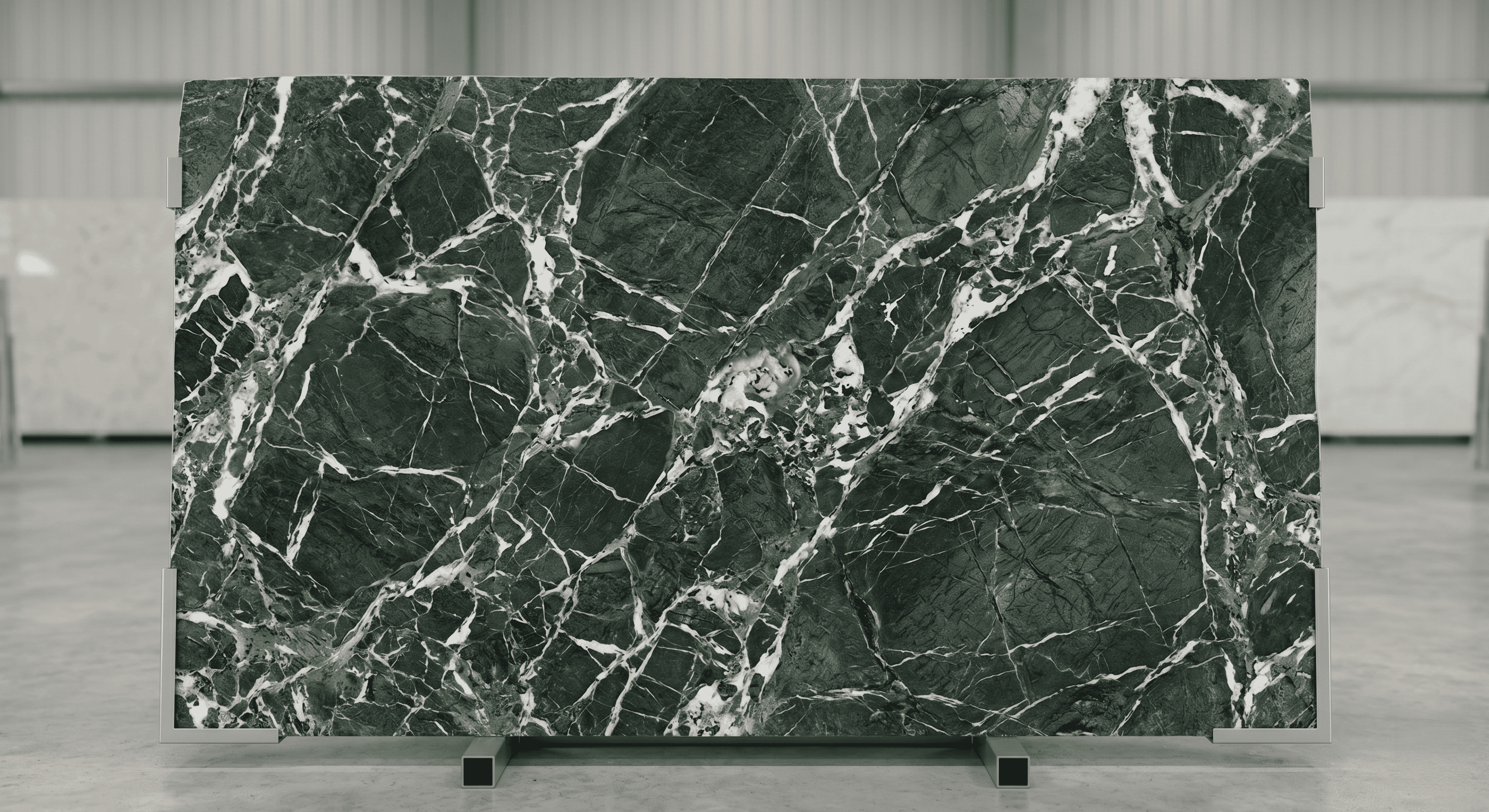
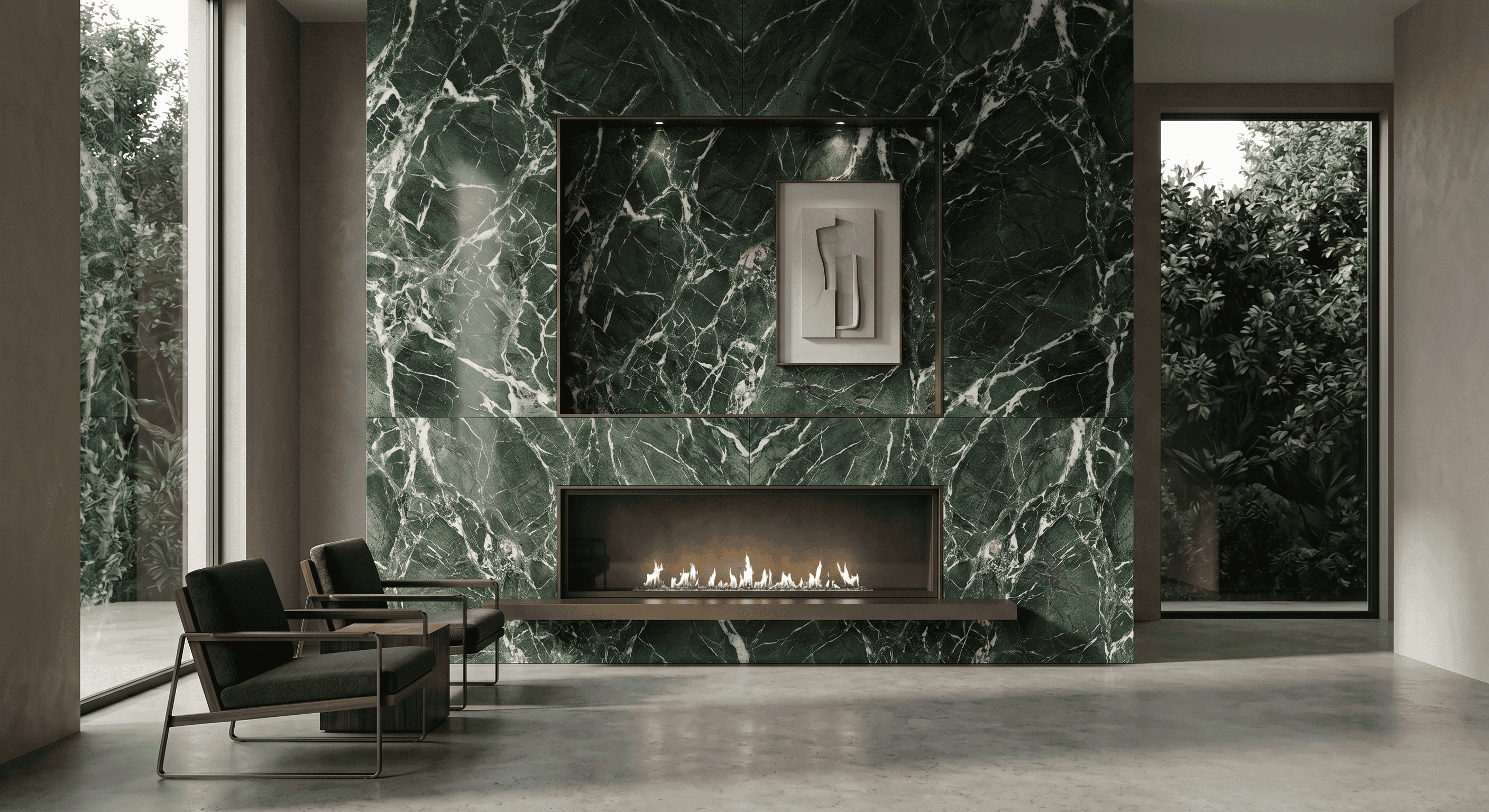
Scale matters as well. Strongly veined green marble may need space for its movement to resolve. A quieter green quartzite may work well across larger planes where continuity is important. In bathrooms, the stone can create a spa-like quality without becoming generic. In kitchens, it can anchor the room and offer an alternative to the familiar language of white marble or pale quartzite. In living spaces, a green stone fireplace or wall surface can give the room a sense of gravity.
Selection, Judgment, and Expertise
Digital images are useful for first impressions, but they rarely capture the full behavior of green stone. Screens can distort undertones, compress contrast, and flatten movement. A slab that appears bold online may feel more composed in person. Another that seems quiet in a photograph may reveal remarkable depth when seen at full scale.
This is why in-person selection remains important. Standing in front of a slab allows designers and homeowners to understand proportion, direction, variation, and finish in a way that cannot be fully translated through photography. The eye begins to notice where movement gathers, where color softens, where a vein might be centered or avoided, and how the stone might be divided for fabrication.
At GEM International, this kind of evaluation is part of the broader material conversation. The role of a stone supplier is not simply to present inventory, but to help clarify what the material is doing and how it may behave in a real project. That quiet layer of experience can influence everything from slab selection to application, especially when working with expressive stones such as Moulin Vert, Verde Aver, or other green natural stones.
Good judgment often appears subtle in the finished room. It may be seen in the way a vein continues across a surface, the way an edge profile does not compete with the stone, or the way surrounding materials allow the green to feel intentional rather than isolated. The result is not about making the stone louder. It is about giving the material the right context.
In the Long View
Green stone endures because it offers more than color. It brings atmosphere, depth, and a connection to the natural world without relying on literal references to nature. It can feel composed, architectural, and quietly expressive. In a field where many surfaces are selected for immediate effect, green stone often rewards a more patient form of attention.
Its appeal is not limited to one style of interior. It can support restraint, richness, contrast, softness, or structure depending on the stone and the way it is used. That flexibility is part of its strength. A well-selected green marble or quartzite does not simply decorate a space. It gives the room a material center.
The most successful decisions tend to come from looking closely, comparing carefully, and allowing the stone to be understood in full scale. For designers, architects, builders, and homeowners considering green natural stone, the conversation often begins most clearly in person, where tone, movement, finish, and proportion can be experienced directly at the GEM International showroom.